
Vol. 71 No. 4 (2023): Art, Aesthetics, and Artificial Intelligence
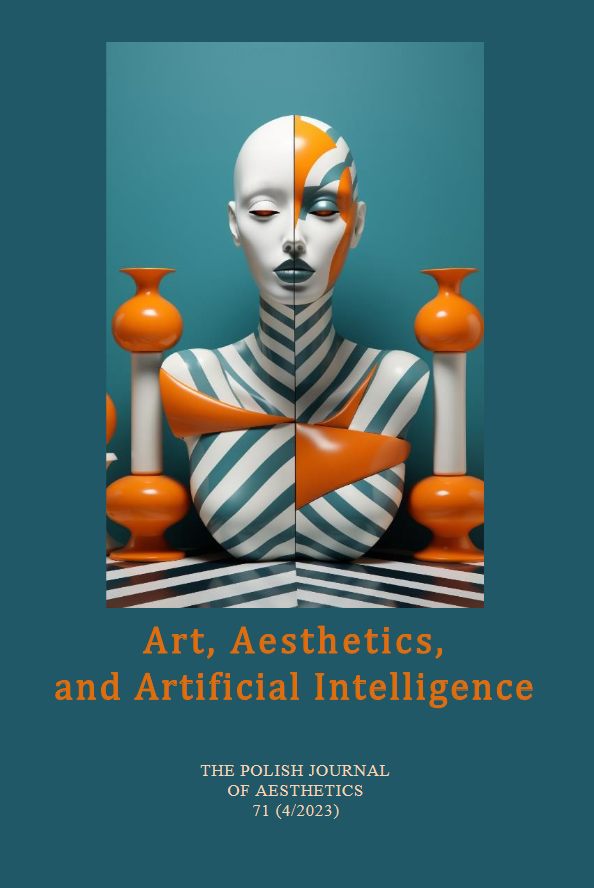
In the winter of 2022, with the launch of ChatGPT and the pursuit of advancing Large Language Models, artificial intelligence (AI) and machine learning quickly appeared in the mainstream of the social, scientific, and artistic debate. While the use of AI in social and scientific development is widely accepted and advanced in art and creative work, the presence of AI is not so obvious and undisputed. Many artists reach for AI as a tool enabling them to accomplish their artistic intentions. At the same time, AI is not original and has already raised plagiarism and copyright problems within the context of the arts, including visual art. Still, the output generated by AI in the role of a non-human automatic agent significantly impacts an audience’s imagination. For many recipients of art, this is proof that also, in this sphere, human, technical skills can be replaced by machines. More and more often, there are voices that the artist’s profession will soon share the fate of such non-existent professions as carriage makers, slubber doffers, pin setters, or knocker-uppers. In a more moderate version, there is a widespread opinion that an artist’s work will be fully automated and—to quote the words of José Ortega y Gasset—dehumanized. On the other hand, AI technology enthusiasts argue it may be time to humanize the algorithm, recognizing its ability to produce artifacts and independently create new art, which in its aesthetic values and impact is equal to the achievements of non-computational human artists.
Research published in “Empirical Studies in the Arts” in 2022 (Gangadharbatla) shows that most people are unable to recognize the differences between images created by artificial intelligence and humans. The inspiration for the study was the sale of the portrait “Edmond de Belamy,” created by an algorithm developed by the Parisian collective Obvious and sold in 2018 at Christie’s auction house. Even though the painting was valued at $7,000-10,000 before the auction, its final price was $432,500. The author of the study, Harsha Gangadharbatla, prepared a survey in which participants had to distinguish between two types of works. Some of them were created by two American artists, Tom Bailey and Steve Johnson, who prepared impressionistic landscapes and geometric abstractions, the other part of the works was created by one algorithm.
Hundreds of people participating in the study were able to correctly attribute only one of the five landscapes to artificial intelligence. More than 75% were wrong about the remaining four. The respondents coped slightly better with abstract art, which may indicate that abstraction is identified with artificial intelligence, and landscapes are believed to be the work of
a human hand.
Philosophical discussions about art created by AI and algorithms usually center around what is known as generative art. New media researcher Philip Galanter writes that “Generative art refers to any art practice where the artist uses a system, such as a set of natural language rules, a computer program, machine, or other procedural invention, which is set into motion with some degree of autonomy contributing to or resulting in a completed work of art” (2003, 4). Generative art defines unique and unpredictable events and entails new artistic processes and challenges. Artistic creation does not serve so much to create artifacts as a program constituting a new natural and artificial environment. Undoubtedly, art created with the help of a special program and AI technology recontextualizes our understanding of skills and art. It does not exactly reproduce existing forms but gains the potential to create new phenomena based on existing artistic practices. This probably implies developing art as a creative practice within all existing fields. Still, at the same time, it brings numerous challenges and questions of a philosophical and aesthetic nature, such as the art of “prompt engineering,” which may be compared to an emergent genre of text, such as poetry and prose.
We hope that the articles collected in this special volume will contribute to the development of the current debate on the relationship between artificial intelligence and art. However, this development does not always mean providing final answers to the questions generated by this contemporary phenomenon. The development of the debate on the presence of artificial intelligence in the world of art and culture today means, above all, asking important and fundamental questions about the future of these areas of human activity and creativity.
To this end, we invited researchers to explore the relationship between art, aesthetics, and artificial intelligence. In this volume of The Polish Journal of Aesthetics we posed some basic questions such as what is AI creation?; is it a work of art?; how is the status and understanding of works of art changing in the age of AI?; how is the status and importance of artists changing in the age of AI?; is AI an artist?; to what extent can AI-generated art be considered original or creative?; who is responsible for AI-generated art, and who owns it?; will AI art reflect the biases of its creators and perpetuate existing inequalities?; how is the understanding of traditional artistic and aesthetic values changing with AI?; does the aesthetic experience of works create by AI change, and how?; does the awareness that AI created a given work affect its reception, and how?
We invite all readers to search for answers to the above questions and reflect on the meaning and presence of AI in contemporary world of art and culture.
Natalia Anna Michna
Bibliography
Galanter Philip (2003), What is Generative Art? Complexity Theory as a Context for Art Theory, [online] http://www.philipgalanter.com/downloads/ga2003_paper.pdf.
Gangadharbatla Harsha (2022), “The Role of AI Attribution Knowledge in the Evaluation of Artwork”, Empirical Studies of the Arts, 40 (2), [online] https://journals.sagepub.com/doi/abs/10.1177/0276237421994697.
Published:
04-12-2023