
Archives
-

The Beauty of Storytelling and the Story of Beauty
Vol. 75 No. 2 (2025)Under the title The Beauty of Storytelling and the Story of Beauty, this special issue of The Polish Journal of Aesthetics explores the intricate and reciprocal relationship between the narrative impulse and aesthetic valuation, asking how beauty emerges, transforms, and persists within acts of narration. Storytelling has accompanied humanity since the dawn of time: as long as human collectives have existed, so too have stories. In the social sciences and humanities, narratives are recognized not merely as forms of entertainment, but as fundamental tools for self-knowledge, the interpretation of the world, and the construction of social bonds. Yet the question remains: what is the place of beauty in this discursive and cultural practice today?
Over a century ago, the artistic avant-gardes challenged the primacy of beauty, displacing it from its position as the paramount aesthetic value in favor of originality, shock, and innovation. In the complex landscape of the twenty-first century, this contestation continues, further complicated by the proliferation of new media and the development of Artificial Intelli gence (AI), which introduce new dimensions for scrutinizing authorship, intentionality, and aesthetic ideals. In a tradition of aesthetic reflection that resists strict formalism, Władysław Tatarkiewicz proposed that beauty may be understood as an inherent feature of narrative itself, encompassing both form and content “whether it be color, sound, or thought.”
This issue argues that the story of beauty is far from over; rather, it is continuously being rewritten through diverse narrative modalities. The volume bears witness to the heterogeneity of storytelling practices, forms, and media, recognizing narrative as a potent vehicle for comprehending reality. From ancient myths and legends to contemporary reportages, immersive digital environments, and algorithmically generated stories, the essence of storytelling remains remarkably resilient. It enables the taming of fears, the preservation of cultural values, and the projection of possible futures. Through stories, the past intersects with the future, and individual experi ences are woven into the rich fabric of collective memory.
The contributions gathered in this issue approach storytelling not only as an art form, but also as a methodological perspective, particularly within art-based research and qualitative inquiry. Drawing on narrative, several texts examine biographical and experiential accounts as instruments of meaning-making and identity construction. At the same time, the volume acknowledges an inherent ambivalence toward storytelling. On the one hand, narratives are valued for their authenticity, emotional resonance, and capacity to evoke empathy; on the other, they demand critical vigilance. The subtle play of emotions may blur the boundary between sincerity and staging, between shared meaning and manipulation.
Importantly, this volume expands the notion of storytelling beyond verbal language. Stories do not always require words; they can be conveyed with equal force through images, sounds, dace, choreography, gestures, mu sic and performance practices. Design occupies a particular place within this expanded field, revealing patterns of existence and experience that often elude traditional scientific description.
In The Beauty of Storytelling and the Story of Beauty, we invite readers to reflect on the contemporary condition of beauty as a fundamental aspect of narrative experience. The volume explores how human and non-human agencies, including AI, coexist in the creation of stories across time, cultures, and continents, reshaping established notions of authorship, creativity, and aesthetic responsibility. Whether digital, organic, embodied, or hybrid, narratives continue to enchant, persuade, and structure our understanding of the world. This issue ultimately proposes a renewed engagement with the classical Greek triad of truth, goodness, and beauty, reconsidered through the prism of narrative complexity, medial plurality, and contem porary cultural challenges. We ask, finally: is there still a place for beauty in the stories we tell about ourselves and our world, and if so, how is it being reimagined today?
Joanna Szczepanik, Kalina Kukiełko
-
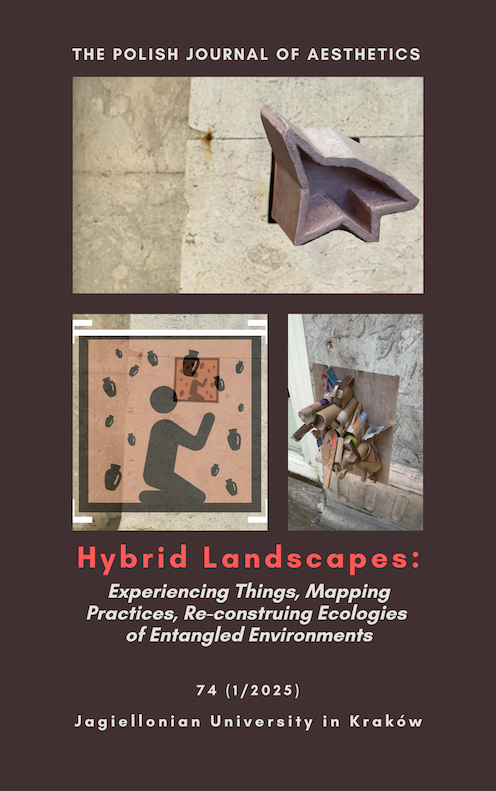
Hybrid Landscapes: Experiencing Things, Mapping Practices, Re-construing Ecologies of Entangled Environments
Vol. 74 No. 1 (2025)Under the title Hybrid Landscapes: Experiencing Things, Mapping Practices, Re-construing Ecologies of Entangled Environments, we present testimony to the heterogeneity of entangled realities featured in this special issue. The notion of materiality has been offered as a mutable, non-privileged point of view, as being-in-the-world as an agential statement opens a myriad of key subjects and decolonizes matter within the entanglements of discursive-material practices. The “hybrid landscapes” issue presents embodied discourses, agencies, identities, and places that can be perceived in diverse time-lapse choreographies as they slice, incorporate, reject, reposition, and transform themselves according to the heterogeneity of realities: digital, organic, extracted, politicized, naturalized, artificialized, economized, liberalized, globalized, colonized, gendered, racialized, nationalized, and capitalized.
Accordingly, human and non-human actants, agencies, and dynamics are transformed into diverse cycles of temporalities that may overlap, coexist, and intersect, all compounding vibrant materiality.
Concerning landscape studies, when one examines places, spaces, and relationships, it becomes a matter of reconfiguring the experience with things and the material agencies at play between what we might (re)nominate as humans, quasi-humans, and non-humans. These impermanent and situated configurations embrace agency, embody other forms of knowledge, and exist in transitoriness, emergence, and urgency as nomadic subjects and vibrant matters, while envisaging a more-than-human world.
Both the terms “landscape” and “hybrid” agglutinate such urgent thoughts needed to shift from human-centered positions as inscribed in Western and Eurocentric modes of knowledge. These can also be connected to other forms of knowledge, such as indigenous studies and indigenous traditional practices of thought, which have been incorporating agency concerning the relationship between nature and culture. Thus, “Hybrid Landscapes” addresses, transversely, artistic, human, and social sciences practices and research experiences that encompass questions regarding what/when/how a hybrid landscape might manifest, whether through narrative research, embodied practices, deep mapping, or art-based reflexive practices that contribute to and unfold the existence and manifestations of agents’ experiences and mutual interconnections.
Helena Elias (University of Lisbon),
Jakub Petri (Jagiellonian University in Krakow),
and Natalia Anna Michna (Jagiellonian University in Krakow) -
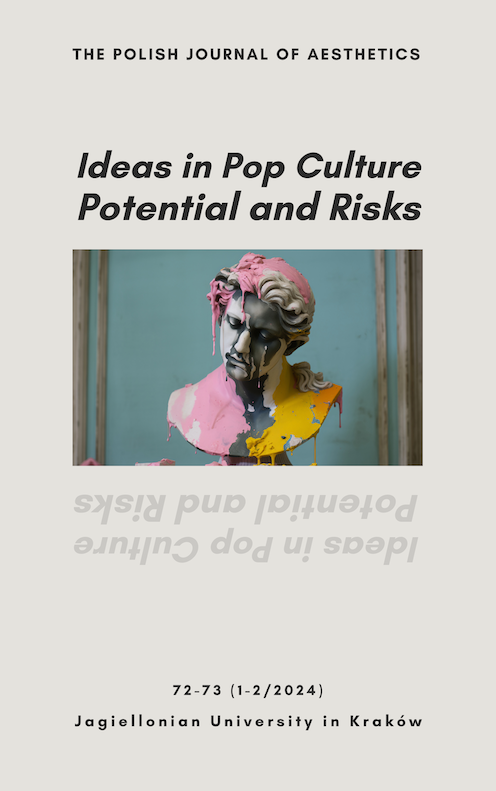
Ideas in Pop Culture – Potential and Risks
Vol. 72 No. 1 (2024)72-73 (1-2/2024)
Ideas, multifaceted in nature, embody thoughts, beliefs, and abstract representations of concepts or entities. Their manifestation and propagation occur through diverse techniques across various media and genres. As we navigate the 21st century, a world dominated by popular culture, it is only natural that the role of ideas in this phenomenon should become the subject of broad, multidisciplinary studies.
We are constantly surrounded by ideas—whether widely accepted or contested—that leave a profound mark on our lives, traditions, and collective consciousness. As Jeffrey Hart observes, “Ideas manifest themselves as opinions, slogans, parts of seemingly coherent structures, and they exist at the core of many of our attitudes” (Hart 1976). This issue examines the mechanisms through which intellectual constructs operate within popular culture. To do so, we must move beyond abstract theorization and seek a definition grounded in empirical realities.
The origins of these conceptual structures lie in beliefs, attitudes, perceptions, and emotions. These elements shape how they emerge, spread, and take hold within society. Rooted in emotions deep-seated assumptions, they ultimately translate into feelings, values, behaviors, and dominant worldviews. Expressed through art, media, and social interactions public
discourse, they play a crucial role in shaping collective consciousness and cultural movements. Ideas therefore are social constructs and to some extent serve social needs. (Hart 1976).One of the most significant roles these frameworks play in popular culture is fostering a connection between audiences and cultural texts. Whether reinforcing pre-existing assumptions or challenging dominant narratives, they elicit an emotional response—an essential condition for popular culture’s resonance and impact. Furthermore, cultural production does not merely reflect prevailing thought; it actively transmits and reshapes it. In this way, cultural works have the power to transform societal norms, influence
behavior, and redefine aesthetic and ideological trends.The relationship between popular culture and intellectual currents is reciprocal and multidimensional. Cultural texts engage with dominant worldviews in various ways—sometimes as overt vehicles for propaganda, sometimes through more subtle or ambiguous representations. Regardless of intent, the influence of mass media and entertainment on public discourse is undeniable.
At the same time, ideas shape culture in passive ways. A work of art or media does not need to be explicitly designed to propagate certain viewpoints in order to be influenced by them. Cultural texts inevitably reflect the ideological frameworks of their time, reinforcing or subverting them in ways that may be conscious or unconscious. Yet, popular culture is not
merely a repository of inherited worldviews; it actively reshapes them. The ways in which artistic and commercial entertainment reframes dominant narratives—sometimes altering their meaning or even rendering them contentious—deserve careful scholarly attention.Historically, art and aesthetics have served as powerful mediums for both promoting and challenging prevailing ideologies. Today, popular culture has assumed a similar role, becoming one of the most potent vehicles for expressing and disseminating intellectual discourse. The intersection of aesthetics, ideas, and entertainment is particularly salient in contemporary society, making it an essential area of academic exploration.
Given this landscape, we sought to contribute to the study of ideas in popular culture by curating this special issue. The range of topics explored in this volume underscores the necessity of a multidisciplinary approach, engaging with diverse perspectives and methodologies.
In his paper, Wojciech Klimczyk examines the intersection of nationalism and Wikipedia’s editorial practices, focusing on the way Polish comics related articles are shaped by nationalist discourse. As history and contemporary events demonstrate, nationalism is a powerful and complex force—even within seemingly niche cultural domains such as comics.
Breogán Torres Gutiérrez offers a compelling analysis of the concept of landscape in Galician culture as a reflection of linguistic diglossia between Galician and Spanish. His paper explores the cultural and political tensions that arise from regional differences, demonstrating how worldviews are embedded in local identity.
Elżbieta Olzacka’s study, which has gained even greater relevance since the inception of this issue, investigates post-Maidan Ukrainian cinema in the context of Russian aggression. This research provides valuable insights into how civilizational imaginaries are represented in popular culture and how they, in turn, shape public perception and geopolitical narratives.
Irene Breuer’s article highlights the presence of pop-cultural narratives—particularly those related to ideas—not only in literature and film but also in architecture and visual arts. By exploring unexpected spaces where cultural discourse unfolds, this work offers a unique perspective on how aesthetic forms shape intellectual engagement.
Adam Danek examines the dialectics of secularization in the Warhammer 40,000 universe, a franchise that has expanded beyond gaming into various media forms. His analysis of religious motifs within this dystopian setting provides an insightful look into the interplay between belief systems and speculative fiction.
Mousumi Sen and Sanchari Chattopadhyay explore the process of dequeering in Indian media, specifically in relation to the series Made in Heaven. As discussions on gender and sexuality continue to evolve, studies such as this one contribute to our understanding of how mainstream narratives negotiate and reshape representations of marginalized identities.
Kamila Grabowska-Derlatka focuses on contemporary aesthetics in the works of Atsushi Ohkubo, whose gothic-inspired manga showcases how visual style intersects with thematic concerns. Her analysis offers another compelling example of how ideas are embedded in artistic expression.The breadth of topics and approaches presented in this special issue demonstrates the profound role that ideas play in shaping both cultural production and everyday life. Given the omnipresence of popular culture, its engagement with ideologies, narratives, and belief systems merits complex and multifaceted scholarly investigation. We hope that this volume contributes to the field and inspires further research and debate on the intricate connections between thought and cultural expression.
Agnieszka Mikrut-Żaczkiewicz & Paweł Dybała
Bibliography
Hart Jeffrey (1976), “Ideas in Culture”, Imprimis, Hillsdale College, [online] https://impri
mis.hillsdale.edu/ideas-in-culture-november-1976/ [Accessed February 26, 2025]. -
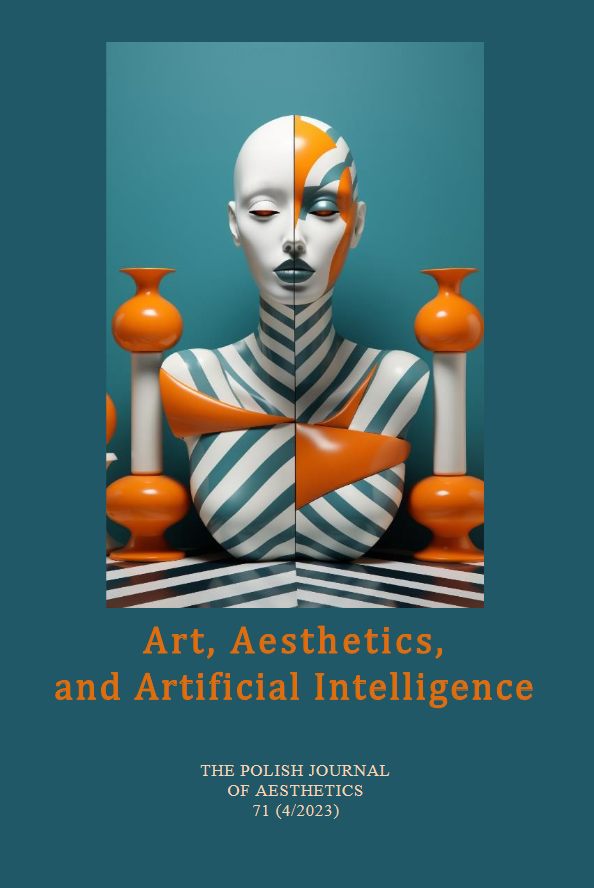
Art, Aesthetics, and Artificial Intelligence
Vol. 71 No. 4 (2023)In the winter of 2022, with the launch of ChatGPT and the pursuit of advancing Large Language Models, artificial intelligence (AI) and machine learning quickly appeared in the mainstream of the social, scientific, and artistic debate. While the use of AI in social and scientific development is widely accepted and advanced in art and creative work, the presence of AI is not so obvious and undisputed. Many artists reach for AI as a tool enabling them to accomplish their artistic intentions. At the same time, AI is not original and has already raised plagiarism and copyright problems within the context of the arts, including visual art. Still, the output generated by AI in the role of a non-human automatic agent significantly impacts an audience’s imagination. For many recipients of art, this is proof that also, in this sphere, human, technical skills can be replaced by machines. More and more often, there are voices that the artist’s profession will soon share the fate of such non-existent professions as carriage makers, slubber doffers, pin setters, or knocker-uppers. In a more moderate version, there is a widespread opinion that an artist’s work will be fully automated and—to quote the words of José Ortega y Gasset—dehumanized. On the other hand, AI technology enthusiasts argue it may be time to humanize the algorithm, recognizing its ability to produce artifacts and independently create new art, which in its aesthetic values and impact is equal to the achievements of non-computational human artists.
Research published in “Empirical Studies in the Arts” in 2022 (Gangadharbatla) shows that most people are unable to recognize the differences between images created by artificial intelligence and humans. The inspiration for the study was the sale of the portrait “Edmond de Belamy,” created by an algorithm developed by the Parisian collective Obvious and sold in 2018 at Christie’s auction house. Even though the painting was valued at $7,000-10,000 before the auction, its final price was $432,500. The author of the study, Harsha Gangadharbatla, prepared a survey in which participants had to distinguish between two types of works. Some of them were created by two American artists, Tom Bailey and Steve Johnson, who prepared impressionistic landscapes and geometric abstractions, the other part of the works was created by one algorithm.
Hundreds of people participating in the study were able to correctly attribute only one of the five landscapes to artificial intelligence. More than 75% were wrong about the remaining four. The respondents coped slightly better with abstract art, which may indicate that abstraction is identified with artificial intelligence, and landscapes are believed to be the work of
a human hand.Philosophical discussions about art created by AI and algorithms usually center around what is known as generative art. New media researcher Philip Galanter writes that “Generative art refers to any art practice where the artist uses a system, such as a set of natural language rules, a computer program, machine, or other procedural invention, which is set into motion with some degree of autonomy contributing to or resulting in a completed work of art” (2003, 4). Generative art defines unique and unpredictable events and entails new artistic processes and challenges. Artistic creation does not serve so much to create artifacts as a program constituting a new natural and artificial environment. Undoubtedly, art created with the help of a special program and AI technology recontextualizes our understanding of skills and art. It does not exactly reproduce existing forms but gains the potential to create new phenomena based on existing artistic practices. This probably implies developing art as a creative practice within all existing fields. Still, at the same time, it brings numerous challenges and questions of a philosophical and aesthetic nature, such as the art of “prompt engineering,” which may be compared to an emergent genre of text, such as poetry and prose.
We hope that the articles collected in this special volume will contribute to the development of the current debate on the relationship between artificial intelligence and art. However, this development does not always mean providing final answers to the questions generated by this contemporary phenomenon. The development of the debate on the presence of artificial intelligence in the world of art and culture today means, above all, asking important and fundamental questions about the future of these areas of human activity and creativity.
To this end, we invited researchers to explore the relationship between art, aesthetics, and artificial intelligence. In this volume of The Polish Journal of Aesthetics we posed some basic questions such as what is AI creation?; is it a work of art?; how is the status and understanding of works of art changing in the age of AI?; how is the status and importance of artists changing in the age of AI?; is AI an artist?; to what extent can AI-generated art be considered original or creative?; who is responsible for AI-generated art, and who owns it?; will AI art reflect the biases of its creators and perpetuate existing inequalities?; how is the understanding of traditional artistic and aesthetic values changing with AI?; does the aesthetic experience of works create by AI change, and how?; does the awareness that AI created a given work affect its reception, and how?
We invite all readers to search for answers to the above questions and reflect on the meaning and presence of AI in contemporary world of art and culture.
Natalia Anna Michna
Bibliography
Galanter Philip (2003), What is Generative Art? Complexity Theory as a Context for Art Theory, [online] http://www.philipgalanter.com/downloads/ga2003_paper.pdf.
Gangadharbatla Harsha (2022), “The Role of AI Attribution Knowledge in the Evaluation of Artwork”, Empirical Studies of the Arts, 40 (2), [online] https://journals.sagepub.com/doi/abs/10.1177/0276237421994697.
-
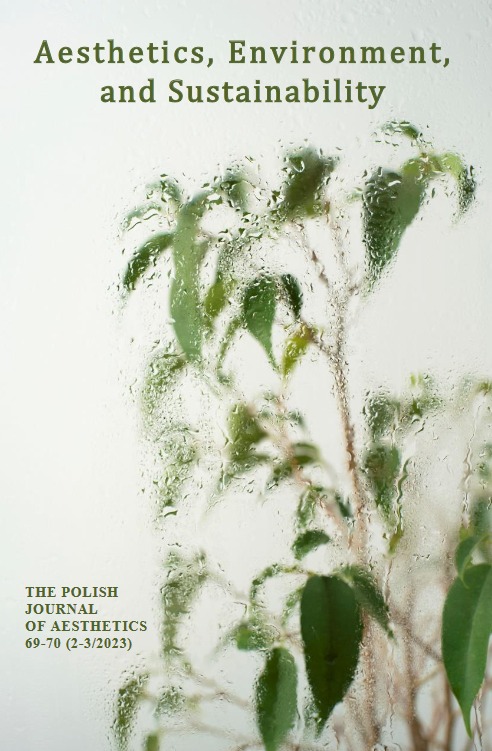
Aesthetics, Environment, and Sustainability
Vol. 69 No. 2-3 (2023)69-70 (2-3/2023)
The past three decades have witnessed a growing awareness of climate change and its impacts on people and the natural environment. It has become increasingly clear that addressing this issue requires technical solutions and, perhaps primarily, a new ecological or green culture. This recognition has led to the understanding that ecology encompasses not just the natural sciences but also the social sciences and humanities, including philosophy. “Sustainability” is an umbrella term for the multidimensional shift needed to counteract the climate crisis.
For instance, despite efforts, we are still far from achieving the United Nations’ sustainability goals (UN SDGs). However, the rise of sustainability-related discussion and work has fostered increasing interest in concepts such as care, respect, accountability, and ethical development within the human community. Philosophical aesthetics have addressed these issues, especially in environmental and everyday aesthetics. The significance of environmental aesthetics extends beyond addressing the sustainability agenda to providing
philosophical insights into human and natural environments, their aesthetic qualities, and the interplay between these and non-aesthetic qualities. Thus, environmental and everyday aesthetics represent an inspiring interface between philosophical or applied aesthetics and the pursuit of ecological and social sustainability.In light of the sustainability agenda, it is imperative for philosophy to do more than interpret the world—it should aim to change it. However, this does not necessitate a shift towards direct activism. Contrarily, philosophical aesthetics often remains within the bounds of theoretical thinking. This approach does not imply a disinterested contemplation of the world as merely an aesthetic phenomenon. As a branch of philosophy, aesthetics aids in understanding the world’s intricacies, tensions, and contradictions and anticipating and evaluating opportunities, challenges, and threats. The theoretical dimension of aesthetics is practically valuable, as it provides a foundation for recommendations on fostering a more sustainable future, including what should or should not be done, how, and why.
Philosophical aesthetics can achieve this aim in various ways: by applying traditional aesthetic concepts to new or overlooked experiences of nature, by showing how philosophical concepts not typically associated with environmental issues can advance the sustainability agenda, by interpreting well-known aspects of modern culture in a new “green” light or by examining specific, singular manifestations of contemporary culture; and by providing arguments for decision-making in areas seemingly distant from philosophical discussions.
The articles in this volume illustrate how philosophical aesthetics can combine its theoretical dimension with practical significance. Stephanie Schuster discusses the aesthetic experience of natural phenomena on a sublime temporal scale, arguing that such experiences can engender a sense of being “at home in the natural world.” Elena Romagnoli draws on hermeneutics to interpret landscape sustainability regarding situatedness, advocating for an immersive and participatory approach to landscapes. Zoltán Somhegyi examines the evolving meanings of ruins and ruination in the context of changing sustainability perspectives. Adrienne Gálosi explores sustainable aesthetic appreciation in gardens, where humans cultivate nature. Finally, Matti Tainio and Minna Santaoja demonstrate how aesthetic considerations influence technical practices. Tainio focuses on night-time illumination, high
lighting its multispecies sustainability implications, while Santaoja advocates for reevaluating aesthetic values in peatland restoration, underscoring the importance of tolerating, or even embracing, awkwardness during sustainability transitions.Sustainability has become increasingly prominent in contemporary aesthetics. The XV International Summer Conference, organized by the International Institute of Applied Aesthetics in June 2023, is a testament to this. Supported by the City of Lahti and in collaboration with the University of Helsinki, the Lahti University Campus Coordination Unit, the Finnish Society for Aesthetics, Päijät-Hämeen Kesäyliopisto, and Visit Lahti, the conference brought together scholars from various academic centers and philosophical traditions. This gathering demonstrated that “sustainable aesthetics” is an evolving field capable of uniting diverse voices in its discourse.
We believe this volume offers a glimpse into sustainable aesthetics that will interest those new to the field while contributing significantly to its ongoing development.
Arto Haapala,
Virpi Kaukio,
Noora-Helena Korpelainen,
Mateusz Salwa