
Vol. 74 No. 1 (2025): Hybrid Landscapes: Experiencing Things, Mapping Practices, Re-construing Ecologies of Entangled Environments
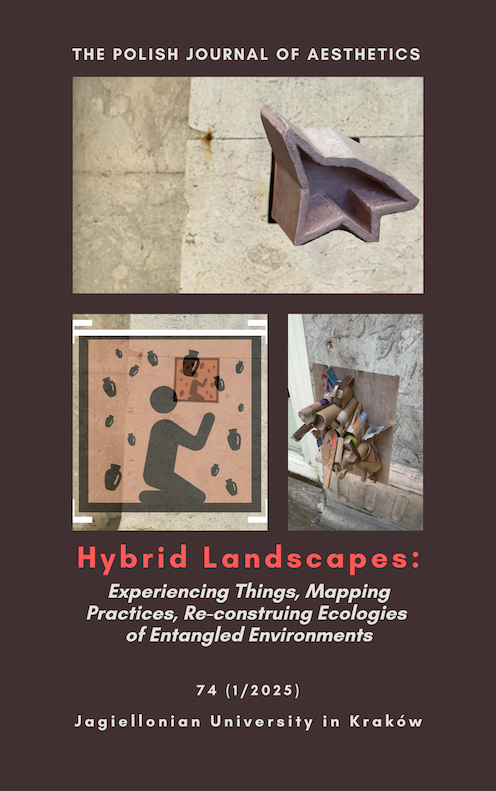
Under the title Hybrid Landscapes: Experiencing Things, Mapping Practices, Re-construing Ecologies of Entangled Environments, we present testimony to the heterogeneity of entangled realities featured in this special issue. The notion of materiality has been offered as a mutable, non-privileged point of view, as being-in-the-world as an agential statement opens a myriad of key subjects and decolonizes matter within the entanglements of discursive-material practices. The “hybrid landscapes” issue presents embodied discourses, agencies, identities, and places that can be perceived in diverse time-lapse choreographies as they slice, incorporate, reject, reposition, and transform themselves according to the heterogeneity of realities: digital, organic, extracted, politicized, naturalized, artificialized, economized, liberalized, globalized, colonized, gendered, racialized, nationalized, and capitalized.
Accordingly, human and non-human actants, agencies, and dynamics are transformed into diverse cycles of temporalities that may overlap, coexist, and intersect, all compounding vibrant materiality.
Concerning landscape studies, when one examines places, spaces, and relationships, it becomes a matter of reconfiguring the experience with things and the material agencies at play between what we might (re)nominate as humans, quasi-humans, and non-humans. These impermanent and situated configurations embrace agency, embody other forms of knowledge, and exist in transitoriness, emergence, and urgency as nomadic subjects and vibrant matters, while envisaging a more-than-human world.
Both the terms “landscape” and “hybrid” agglutinate such urgent thoughts needed to shift from human-centered positions as inscribed in Western and Eurocentric modes of knowledge. These can also be connected to other forms of knowledge, such as indigenous studies and indigenous traditional practices of thought, which have been incorporating agency concerning the relationship between nature and culture. Thus, “Hybrid Landscapes” addresses, transversely, artistic, human, and social sciences practices and research experiences that encompass questions regarding what/when/how a hybrid landscape might manifest, whether through narrative research, embodied practices, deep mapping, or art-based reflexive practices that contribute to and unfold the existence and manifestations of agents’ experiences and mutual interconnections.
Helena Elias (University of Lisbon),
Jakub Petri (Jagiellonian University in Krakow),
and Natalia Anna Michna (Jagiellonian University in Krakow)
Published:
02-07-2025